With NSE IPO approved and the long wait coming to end with proposed listing on 26-Sep-2026 – it is worthwhile to compare how does it stack against BSE with latest quarterly performance and expectation for rest of the FY.
India’s stock market is anchored by two major exchanges—the NSE and the BSE—but their roles differ sharply for long-term investors considering investing in them. While BSE carries legacy and breadth, the NSE stands out with higher liquidity, faster execution, and stronger dominance in derivatives and benchmark indices like Nifty 50 and ranked in top 5 stock market exchange globally.
So does NSE offer better opportunity vs BSE, or other listed players – such as MCX ! With upper price band as cut-off price, I believe the stock to eventually settle closer within 2200-2300 range, with real test of the stock happening late Mar-27 to April-27 when institutions lock-in ends. Let’s look in detail first
|
Feature |
National Stock Exchange (NSE) |
Bombay Stock Exchange (BSE) |
|
Founded |
1992 |
1875 |
|
Origin |
Created as a modern, electronic marketplace to improve transparency |
Started as the Native Share and Stock Brokers’ Association |
|
Status |
Largest financial market in India |
First and oldest stock exchange in India (and Asia) |
|
Global Ranking |
7th largest exchange worldwide (by market capitalization, May 2024) |
Among the largest globally; biggest in India by market capitalization (May 2024) |
|
Market Capitalization (Aug 26) |
~ 4.8 lakh crore (CMP of 2000) |
~1.38 lakh crore (CMP of 3500) |
|
Key Strengths |
High liquidity, advanced technology, ease of trading, liquid derivatives market, |
Wide company listings, strong role in developing capital markets |
|
Number of Listed Companies |
Fewer compared to BSE; focuses on large, liquid stocks |
Nearly 6,000 companies listed, including many SMEs |
|
Popular Index |
NIFTY 50 (tracks top Indian companies) |
SENSEX (tracks 30 major companies) |
|
Markets Covered |
Equity and wholesale debt markets |
Equities, debt instruments, derivatives, SMEs |
|
Innovation |
First fully automated electronic trading platform in India |
First stock exchange in Asia; pioneer in Indian capital markets |
Though NSE is much bigger than BSE financially, BSE shares have been on the run in past 3 years. In-fact, FY 24-25, was the breakout year for BSE financially, and stock price runup reflecting the same too (see below).
*Source : nseindia.com, tradingview
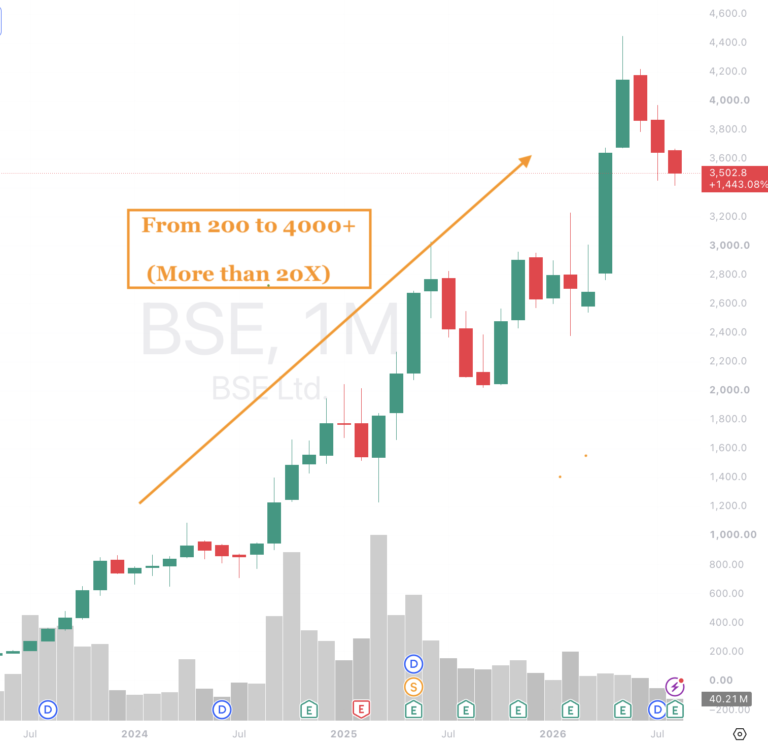
With the first quarter results OUT for both the stocks, and assuming that it can maintain the same performance through rest of the year – the comparison is more interesting than it was a quarter ago. FY25 performance showed explosive growth, but NSE remains the more stable and profitable investment— and more attuned to tackle future challenges, and venturing into new revenue sources. Here’s a detailed breakdown of how the Bombay Stock Exchange (BSE) and National Stock Exchange (NSE) stack up on various parameters, but three things stand out :
| Financial Parameter | NSE India Ltd (at ₹2,000) | BSE Ltd (at ₹3,500) | Strategic Takeaways & Investor Insights |
|---|---|---|---|
| Current Assumed Price | ₹2,000.00 (Unlisted Base) | ₹3,500.00 (Listed Base) | Setting these exact prices removes the unlisted premium disconnect and establishes a clear baseline for fundamental evaluation. |
| Extrapolated Forward P/E | 39.65x | 41.23x | Parity Achieved. The market values both platforms identically, proving that investors demand a near-identical valuation premium for their operational runways. |
| Trailing P/E (TTM) | 47.84x | 50.87x | High trailing multiples are actively being absorbed and digested by the rapid expansion of current-year financial results. |
| Price-to-Book Value (P/B) | 15.34x | 21.51x | BSE commands a higher asset premium. Both are asset-light digital networks with low equity base footprints, naturally yielding elevated P/B ratios. |
| PEG Ratio (Price/Earnings-to-Growth) | 1.24x | 0.86x | BSE Offers Value on Growth. BSE trades at a lower PEG ratio because its recent profit growth rate outpaces NSE, making its ~41x P/E cheaper when adjusted for actual earnings momentum. |
| EBITDA / Operating Margin | 79.0% | 53.5% | NSE Core Dominance. NSE enjoys unrivaled operational leverage because its massive technology systems require very low incremental costs as volumes surge. |
| Market Share (Derivatives ADTV) | ~85% – 87% | ~13% – 15% | NSE rules institutional derivative liquidity. BSE has successfully used unique weekly option expiry cycles to claim its slice, but NSE’s core wall remains high. |
| Number of Listed Companies | ~2,978 Companies | ~5,955 Companies | BSE acts as India’s historical corporate register. Double the listings ensures steady, dependable annuity streams from annual listing and compliance fees. |
| Return on Equity (ROE) | 31.7% | 37.4% | Both companies deliver elite wealth generation. BSE shows a minor edge in squeezing maximum net returns out of its available equity base. |
| Return on Capital Employed (ROCE) | 39.1% | 48.5% | Unleveraged capital efficiency is phenomenally high for both. BSE converts modern trading volume jumps directly into peak capital performance. |
| Dividend Yield | ~1.63% | 0.28% | At ₹2,000, NSE offers a much stronger yield to holders. BSE’s rapid stock price appreciation has heavily compressed its yield despite solid cash payouts. |
| Debt-to-Equity Ratio | 0.00 | 0.00 | Pristine Balance Sheets. Zero long-term debt makes both exchanges completely immune to interest rate hikes or systemic credit tight spots. |
| Liquidity & Trading Vehicle | Off-market / Pre-IPO Network | Live Public Stock Exchange | BSE offers seamless execution on trading screens, whereas NSE shares carry transaction friction and lock-in complexities until the formal IPO. |
Disclaimer: This article is for information purpose only. It is NOT a stock recommendation and should not be treated as such. Please consult your financial advisor before investing. Investing in securities market is subject to market risks. I have a personal holding in NSE (< 1%). Please read full disclosures here.
We share DAILY analysis of key stocks with charts and clear rationale for you to learn and decide. No Trading Advice is given
Disclaimer: This article is for information and education only and is not a stock recommendation. Investments in securities markets are subject to market risks. Read the full disclosures.
Choose structured trading education or explore our research-led trading call services.
Turn market understanding into a practical process with our research-led services.
Services by a SEBI-registered Research Analyst.