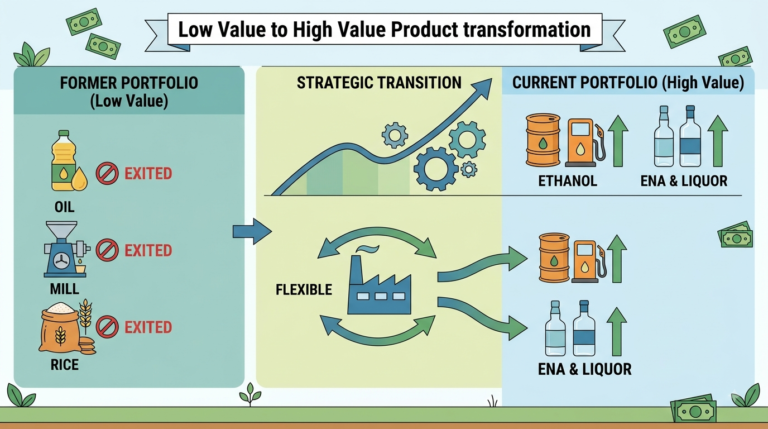
Incorporated in 1976, BCL Industries Limited is a Punjab-based agro-processing company that has gradually transformed from an edible-oil-focused business into a predominantly distillery-led company.
Its key businesses now include grain-based ethanol, Extra Neutral Alcohol (ENA), country liquor, oil trading/refining and real estate. The distillery segment contributed nearly 58% of consolidated operating income in FY26, making it the company’s dominant business.
BCL currently has 900 KLPD of installed grain-based distillery capacity, comprising:
The proposed 250 KLPD Goyal Distillery project in Haryana could eventually increase total capacity to around 1,150 KLPD, subject to project execution and commissioning.
BCL’s business mix has changed significantly over the past few years. The company has exited its packaged edible-oil business and discontinued its oil mill, solvent extraction and rice-mill operations, although soft-oil refining and oil trading continue.
At the same time, the company is increasingly focusing on higher-margin products such as ethanol, ENA and liquor. Its flexible distillery infrastructure also allows production to be shifted between ethanol and ENA depending on OMC allocations and private-market economics.
During FY26, lower-than-expected ethanol allocations and competitive ENA pricing created some pressure. BCL responded by increasing its focus on alternative alcohol markets and improving its product mix.
Another important development was the acquisition of the remaining 25% stake in Svaksha Distillery for ₹55 crore, completed on June 30, 2026. Svaksha is now a wholly owned subsidiary of BCL, giving the company full control over the 350 KLPD West Bengal operation.
BCL’s FY26 performance reflected a clear improvement in profitability despite broadly flat revenue. Consolidated total revenue stood at about ₹2,913 crore versus ₹2,919 crore in FY25, while EBITDA increased 18% to ₹251 crore. EBITDA margin improved to 8.6% from 7.3%, and PAT rose 23% to ₹126 crore.
Key financial trends include:
The numbers indicate that BCL’s improving business mix is supporting better margins and profitability, even while revenue momentum remains uneven. Going forward, the key test will be whether the company can combine stronger margins with higher capacity utilisation, revenue growth and sustainable cash generation.
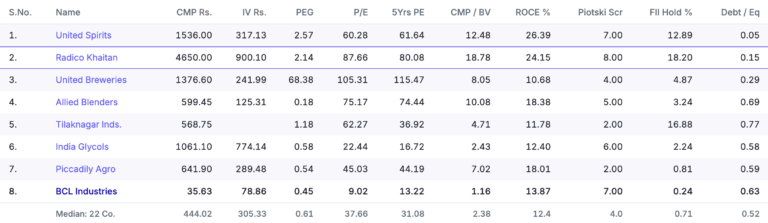
What makes the stock even more compelling is that at the CMP (of ~35-36/-) the stock price is trading below it’s intrinsic value, PEG ratio below 0.5, at lower P/E ratio vs. its historical average alongside lower BV and manageable debt levels.
We share DAILY analysis of key stocks with charts and clear rationale for you to learn and decide. No Trading Advice is given
Several factors could support BCL’s medium-term operating performance:
The key issue, however, is not simply capacity expansion. BCL needs to convert additional capacity into higher utilisation, sustainable margins and stronger returns on capital.
India has already achieved the 20% ethanol-blending milestone, with government data showing E20 blending reached in 2025-26. Ethanol production capacity has also expanded substantially across the industry.
This changes the sector’s growth narrative. The opportunity is no longer based only on reaching E20. Future economics will increasingly depend on:
For BCL, this makes efficient utilisation of existing capacity increasingly important relative to headline capacity announcements.
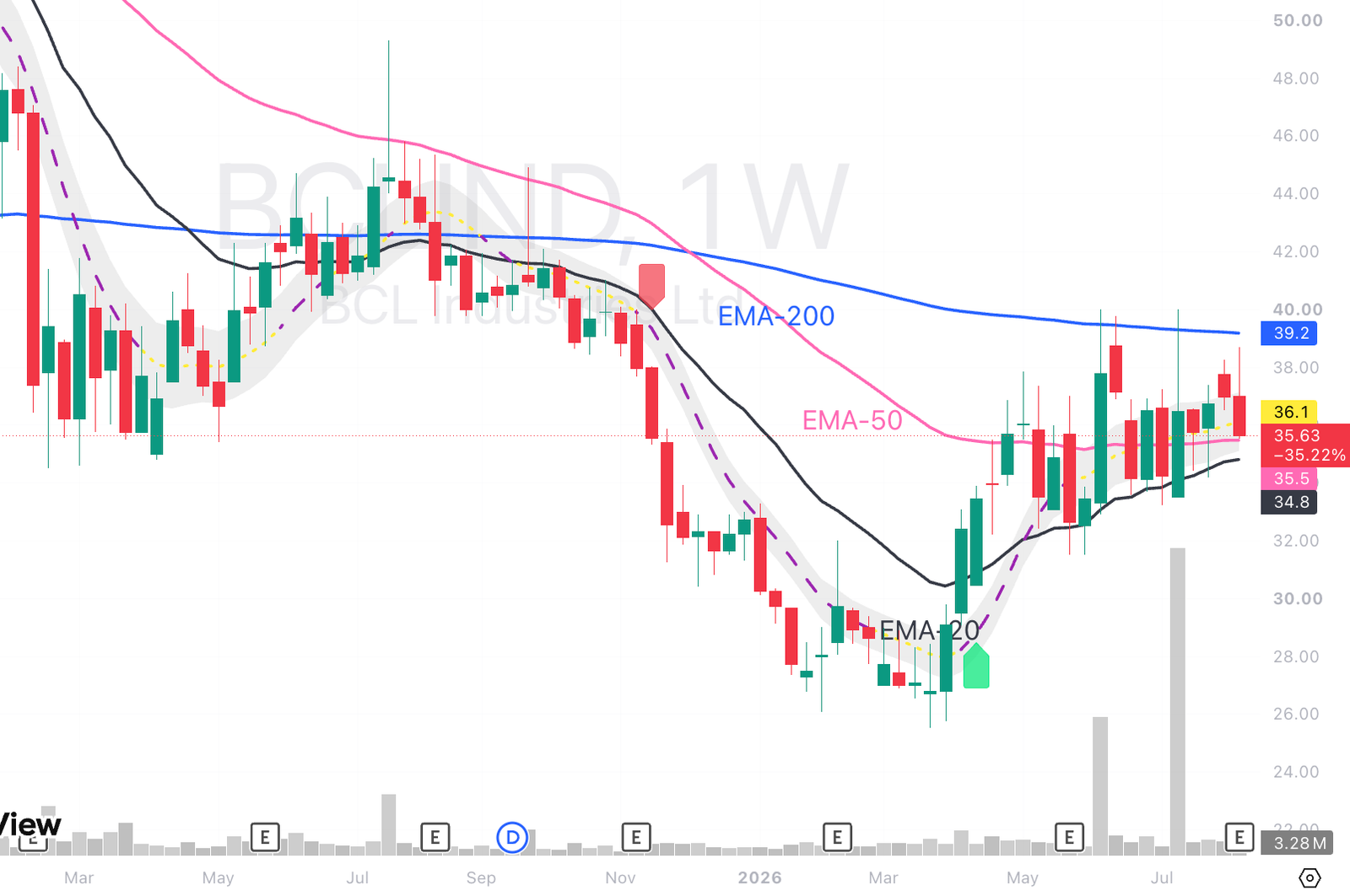
The technical setup remains neutral rather than strongly directional and in consolidation since quite some time, but gradually inching up.
We share DAILY analysis of key stocks with charts and clear rationale for you to learn and decide. No Trading Advice is given
BCL Industries is increasingly emerging as a focused distillery business rather than a traditional diversified agro-processing company.
FY26 showed encouraging signs: EBITDA increased, margins expanded, PAT improved, operating cash flow strengthened and leverage declined, despite limited top-line growth. The existing 900 KLPD distillery platform, full ownership of Svaksha and the proposed Haryana expansion provide additional growth potential.
At the same time, Q1 FY27 highlights an important point: installed capacity alone will not determine future earnings. Revenue declined sharply even as EBITDA and PAT improved, making OMC allocations, utilisation, feedstock prices, ENA realisations and execution increasingly important.
Overall, the operating trend appears constructive, supported by improving profitability and a healthier financial profile. The next phase will depend on whether BCL can translate its larger manufacturing base into consistent volume growth, cash generation and sustainable returns on capital.
—————————–
Disclaimer: This article is purely for information purpose only. This is NOT a stock recommendation and should not be treated as such. Please consult your financial advisor before investing. Investing in securities market is subject to market risks. Please read full disclosures here.
Sources: nseindia (financial reports, company data and announcements via NSE website), tradingview, screener.com, company website.
We share DAILY analysis of key stocks with charts and clear rationale for you to learn and decide. No Trading Advice is given
Disclaimer: This article is for information and education only and is not a stock recommendation. Investments in securities markets are subject to market risks. Read the full disclosures.
Choose structured trading education or explore our research-led trading call services.
Turn market understanding into a practical process with our research-led services.
Services by a SEBI-registered Research Analyst.