Foreign investors have been making headlines for all the wrong reasons lately. They’ve been selling Indian stocks at a rapid pace for months now. Just in the first two months of 2025, they offloaded stocks worth > Rs 1,130 billion (More than 800billion in Jan, and > 300 billion in Feb 2025)!
But here’s something important to remember – despite their recent selling spree, foreign institutional investors (FIIs) love investing in India. They know the Indian market offers solid growth opportunities across various sectors. Historically, FIIs have played a huge role in shaping the market, pushing it up or down depending on their buying or selling trends.
However, things are changing. Indian retail investors—through direct stock investments and mutual funds—are now a force to reckon with. Their growing influence has made the market more resilient. But make no mistake, FIIs still have significant power. When they buy or sell in large amounts, the market follows their lead.
Since the Nifty hit its peak in September 2024, all eyes have been on FIIs. The big question now is: When will they start buying again? Let’s break it down into three key factors:
The selling may not subside soon, as the FAMOUS BUFFET INDICATOR is pegging India mCap/GDP ratio around 137, thereby making it overvalued !
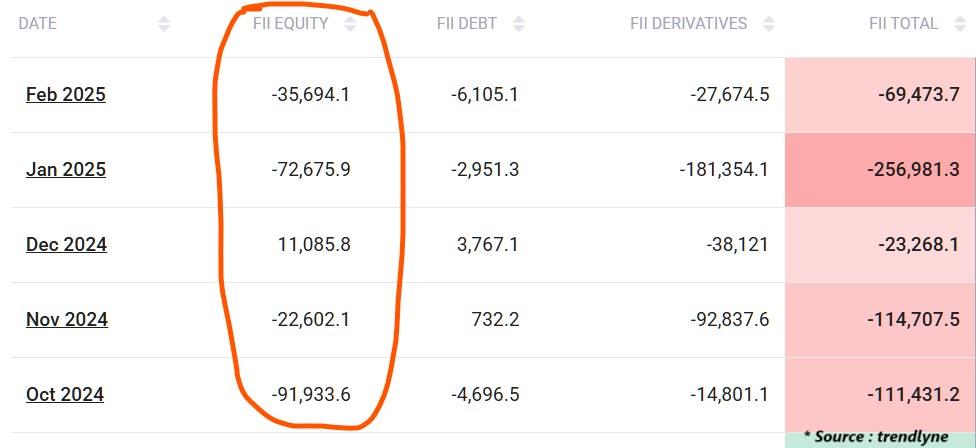
The US government’s new tariff policies under President Trump have created uncertainty in global markets. Since financial markets dislike uncertainty, FIIs have reacted by pulling money from India and moving it back to the US.
India is currently negotiating a major trade deal with the US. If this deal is favorable, it could bring back FII confidence and trigger a fresh round of buying in Indian stocks.
Bottom line: India’s trade relationship with the US will play a big role in how soon FIIs return.
The tariff news will soon become priced in by the markets, and volatility should subside.
Want to MASTER Technical Chart Reading, and Trade or Invest at right Levels? Do checkout out our revamped and simplified “Equity Mentorship” program.
FIIs move money based on global risk trends.
Right now, the global mood is in a ‘risk off’ phase. FIIs are preferring the safety of US assets over Indian stocks. This is due to concerns about India’s slowing economic growth and uncertainty around global trade policies.
But here’s the good news: These cycles always reverse. ‘Risk off’ periods are temporary. When confidence returns, FIIs will come back, and strong Indian stocks will benefit the most.
Smart investors should use this time to position themselves in fundamentally strong companies and stay patient.
Market Asset Allocation is proven to beat any kind of Investing Activity over time. Shift in asset allocation is never permanent and will keep on changing, as market dynamics evolve.
Join our 1-year Mentorship Program to trade markets like a Pro – across all asset classes !.
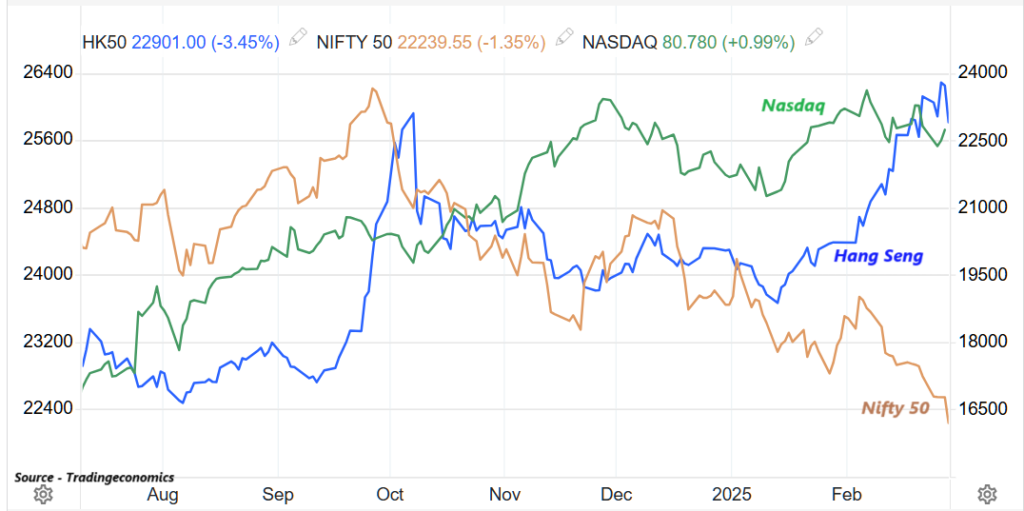
Lately, FIIs have been shifting funds to China. Since October 2024, India’s market cap has dropped by $1 trillion, while China’s has surged by $2 trillion. Why?
It’s a matter of time when Indian Equities also comes down to reasonable valuations to invest.
Should long-term investors worry? Not really.
As a result, many global funds will eventually rebalance their investments, benefiting Indian stocks once again.
FIIs still have a strong influence on certain stocks, especially those where they hold large stakes. If they continue selling, these stocks may stay under pressure. That’s why investors should be cautious when picking stocks with high FII holdings.
However, blindly following FII moves can be risky. Their decisions are often based on global market trends rather than the specific strengths of Indian companies. FIIs also have short-term investment horizons, meaning they might exit quickly, causing volatility.
To build wealth in the long run, investors should:
✅ Focus on fundamentally strong stocks with good management.
✅ Check corporate governance and regulatory risks before investing.
✅ Diversify portfolios to minimize impact from FII actions.
While FIIs are selling now, history shows they always return when conditions improve. India remains a high-growth economy with strong long-term potential.
Rather than reacting to short-term FII moves, investors should stay patient and focus on quality companies. When FIIs come back—and they will—those holding solid stocks will be in the best position to gain.
Disclaimer: This article is for information purpose only. It is NOT a stock recommendation and should not be treated as such. Read full disclosures here.
We share DAILY analysis of key stocks with charts and clear rationale for you to learn and decide. No Trading Advice is given
Disclaimer: This article is for information and education only and is not a stock recommendation. Investments in securities markets are subject to market risks. Read the full disclosures.
Choose structured trading education or explore our research-led trading call services.
Turn market understanding into a practical process with our research-led services.
Services by a SEBI-registered Research Analyst.