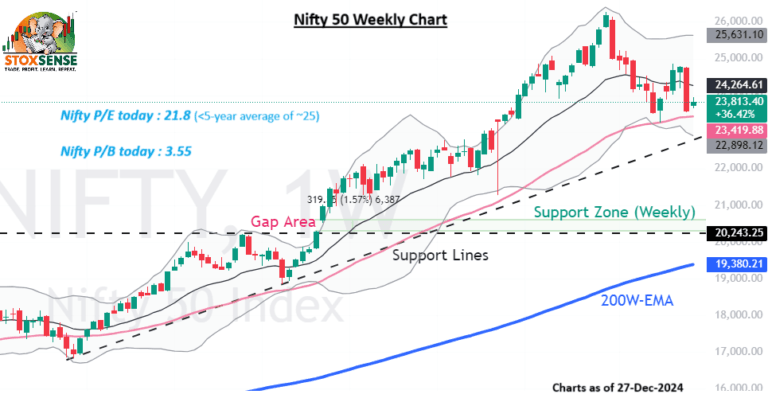
The Indian stock market had an eventful 2024, with some market volatility, but the indices have remained resilient. Despite fluctuations, Nifty 50 has gained approximately 10% this year, while the broader market has significantly outperformed, with the BSE Midcap and BSE Smallcap indices surging by 25% and 30%, respectively.
Nifty seemed to be fairly valued at the moment, but weaker earnings growth can dampen the overall mood of the market in 2025.
Many Individual stocks have posted much higher returns in 2024 than the broader indices, such as Trent at 136%, Oracle Financial at 191%, V2 retail at 424%, Bhart Airtel at 59% etc While certain sectors and stocks have outshone others, the overall trend has been upward, with most stocks posting solid gains or at least avoiding substantial declines.
However, there have been exceptions, with some stocks falling sharply in 2024, such as IndusInd Bank at -41%, Zeel at -53%, Filatex fashions at -71%, HUL at -10% etc. But these losses were mainly due to sector-specific issues or individual stock challenges, rather than a major shift in market sentiment. Could 2025 bring a change in direction? Could a shift from positive sentiment to negative sentiment reverse the entire market trend?
One of the primary drivers of the bullish trend in the Indian stock market has been the relentless flow of liquidity from retail investors, HNIs, and mutual funds, through direct investments or services like portfolio management and family offices. This flood of capital has been critical in supporting expensive market valuations, even though corporate earnings growth has slowed.
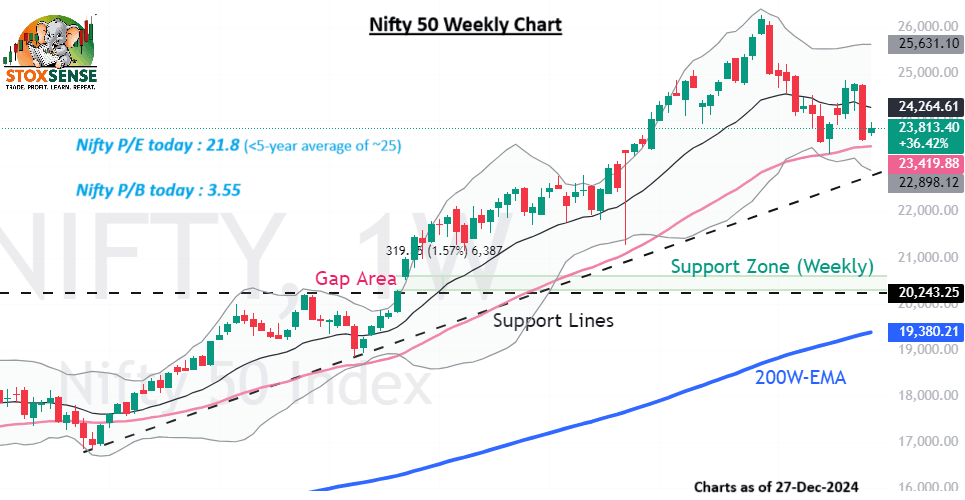
The Nifty PE ratio, a key indicator of market valuation, has remained above 20 for most of the year. Historically, a PE ratio above 25 is considered overvalued. As of 2024’s close, the Nifty PE ratio stands at about ~22, signaling that the market is not overly expensive.
The same applies to the broader market, which is arguably even more expensive than the Nifty. In 2024, midcaps and smallcaps have been in high demand from retail and HNI investors. As a result, the broader market has become pricier than the Nifty
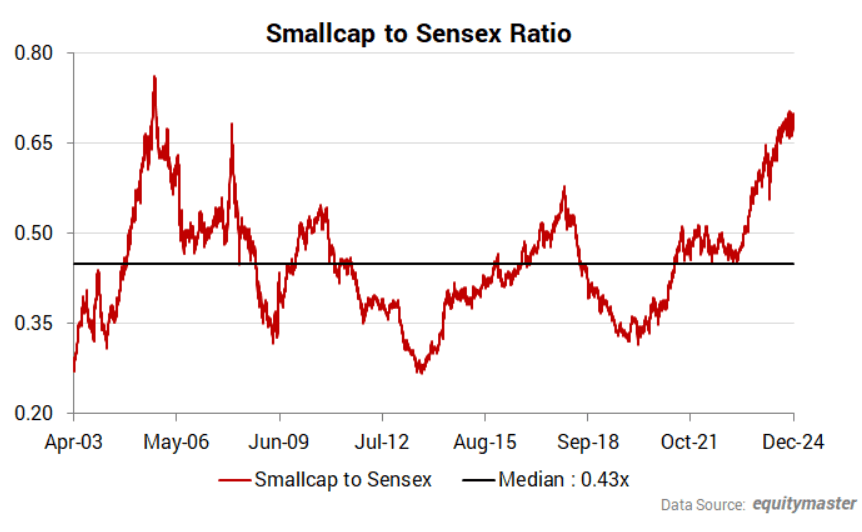
For instance, the Smallcap to Sensex ratio, an important indicator, currently stands at 0.7, far above the long-term median of 0.45, signaling a potential overvaluation. This ratio has been a precursor to significant corrections in the past. The smallcap index could experience a sharp correction if earnings expectations fall short.
India’s real GDP growth for this quarter has dropped to 5.4%, significantly lower than even the most conservative forecasts. This slowdown is also reflected in India Inc’s earnings growth, which has hit its weakest levels since the pandemic. While quarterly growth numbers can fluctuate, what makes this data particularly important is the current market valuations, which are pricing in an overly optimistic scenario.
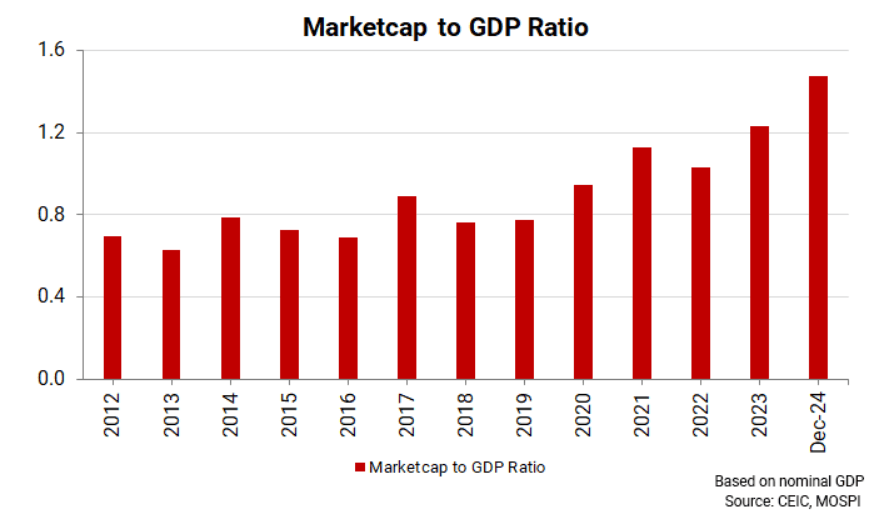
The market capitalization to GDP ratio, often referred to as Warren Buffett’s preferred valuation indicator, stands at 1.47x for India. This is well above the historical median range of 0.9x to 1x over the last decade, indicating that Indian stock market valuations are currently rich or even overvalued.
Looking ahead to 2025, the Nifty and large-cap stocks are not yet in overvalued territory compared to midcaps and smallcaps. This suggests there may be room for further gains in the Nifty index. However, it’s important not to become complacent. A 10-15% rise in the Nifty could push it into overvalued territory, especially without robust earnings growth supporting higher valuations.
The outlook for GDP growth in India appears sluggish, with urban consumption slowing down, making it unlikely that corporate earnings will experience significant growth. In the absence of strong earnings growth, market valuations could be stretched, leading to the risk of overvaluation and a possible market correction.
Despite these risks, positive sentiment and the return of foreign institutional investors (FIIs) could push the market higher. However, a sharp rise could also lead to overvalued conditions, with little room for undervalued stocks.
If you’ve invested in fundamentally strong stocks at reasonable valuations, there’s no immediate action needed. These stocks are positioned for long-term wealth creation. Should the market correct, it could present opportunities to buy at lower prices.
However, be sure to regularly review your portfolio for any stocks that have become overvalued or where the fundamentals have deteriorated. If your original investment thesis no longer holds, consider re-evaluating your positions.
For short-term investors (with a holding period of 3 years or less), there may be more concern about potential corrections. Stocks that have disappointed in earnings or face governance issues could underperform if market sentiment turns negative.
In a rising stock market where earnings growth is slowing, it’s important to exercise caution. While Indian stock market growth in the long term is likely to follow the trajectory of economic growth, selective stock picking and portfolio monitoring are essential, especially in the high-risk sectors like midcaps and smallcaps.
Stay cautious, monitor fundamentals, and be prepared for any market shifts in the coming year.
Happy trading!
Disclaimer: This article is for information purposes only. It is not a stock recommendation and should not be treated as such. Read full disclosures at here
We share DAILY analysis of key stocks with charts and clear rationale for you to learn and decide. No Trading Advice is given
Disclaimer: This article is for information and education only and is not a stock recommendation. Investments in securities markets are subject to market risks. Read the full disclosures.
Choose structured trading education or explore our research-led trading call services.
Turn market understanding into a practical process with our research-led services.
Services by a SEBI-registered Research Analyst.