

HDFC Bank has traditionally commanded a premium valuation among India’s private-sector banks because of its scale, asset quality, deposit franchise and strong return profile – That premium has narrowed sharply.
The stock now trades at around 1.8x book value and 13-14x earnings, well below the valuation levels investors were accustomed to paying for the bank. At the same time, ROE has moderated and net interest margins remain under pressure.
The key question is therefore not simply whether HDFC Bank looks cheap. It is whether the bank can restore its return ratios while continuing to grow the balance sheet.
For banks, price-to-book (P/B) is often more meaningful than PE because the balance sheet is the core of the business. A bank that earns a high ROE on its book value can justify a higher PB multiple than one generating weaker returns. This is particularly relevant for HDFC Bank today.
The bank’s valuation has fallen, but so has its return profile. Therefore, the potential for a valuation re-rating depends heavily on whether ROA and ROE can recover.
The change in valuation is significant.
| Valuation | Historical median | Current |
|---|---|---|
| 1-year median PB | 2.4x | ~1.8x |
| 3-year median PB | 2.7x | ~1.8x |
| 5-year median PB | 2.9x | ~1.8x |
| 10-year median PB | 3.5x | ~1.8x |
The stock is therefore trading at a substantial discount to its own historical valuation.
But this discount has a fundamental explanation. HDFC Bank’s ROE has moderated, NIM has compressed and investors are waiting for the post-merger bank to demonstrate that it can generate higher returns from its much larger balance sheet.
HDFC Bank’s recent return ratios are below the levels that historically supported its premium valuation.
In the June 2026 quarter:
These are still respectable numbers for a large bank, but they are below the level that would make a 2.5-3x PB valuation easy to justify.
The important question is whether these ratios represent a temporary phase or a new normal.
If ROE moves back towards 15% or higher, the current PB could begin to look conservative. If ROE remains around 13-14%, the market may continue assigning a lower multiple.
HDFC Bank’s valuation looks more reasonable when compared with other large private banks.
| Bank | P/E | P/B | ROE |
|---|---|---|---|
| HDFC Bank | ~13-14x | ~1.8x | ~13-14% |
| ICICI Bank | ~17-18x | ~2.6-2.8x | ~15-16% |
| Kotak Mahindra Bank | ~20-21x | ~2.3x | ~11-12% |
| Axis Bank | ~14x | ~1.7-1.8x | ~12-13% |
Source: Screener; latest available market data. Ratios can change with market price and quarterly earnings.
The comparison with ICICI Bank is particularly relevant. ICICI commands a much higher PB, but it is also generating a higher ROE. HDFC Bank, meanwhile, is valued much closer to Axis Bank.
This suggests the market is not questioning the quality of HDFC Bank’s franchise as much as it is questioning how efficiently that franchise can generate returns.
The FY26 numbers provide some evidence that the underlying franchise remains strong.
Management reported:
The important point is that HDFC Bank continued to grow deposits faster than advances, while improving operating efficiency. Management also said the bank expected to grow advances broadly in line with the banking system in FY26 and above system growth in FY27.
This gives the bank a reasonable base from which to improve profitability.
The June quarter showed that the balance sheet continues to expand, but the margin environment remains challenging. The central issue is NIM compression.
When lending yields reprice faster than deposit costs, margins come under pressure. For a bank of HDFC Bank’s size, even a small change in NIM can have a meaningful effect on earnings.
Therefore, investors should focus on whether:
A combination of these factors would allow ROA to improve and, eventually, provide a path towards higher ROE.
The turnaround does not depend on one dramatic change. It is more about improving several operating ratios simultaneously.
HDFC Bank has historically focused on maintaining a strong deposit franchise. In FY26, deposits grew 14.4%, ahead of advances.
This remains important because a stronger deposit base can support loan growth without excessive dependence on higher-cost funding.
The bank’s core cost-to-income ratio improved from 40.5% to 39.5% in FY26.
Further operating leverage could become an important earnings driver as the balance sheet grows.
This is probably the most immediate profitability monitorable.
Management has indicated that asset yields transmitted faster than deposit costs, which contributed to the FY26 NIM decline. As deposit repricing catches up, there is potential for some margin stabilisation, although the timing and extent remain uncertain.
The bank’s strategy is not simply to chase growth.
Management has emphasised quality growth and lower credit costs, which helped keep ROA around 1.9% in FY26 despite NIM pressure.
That combination of controlled credit costs and improving efficiency could be more important for ROE than simply accelerating loan growth.
MD & CEO Sashidhar Jagdishan will retire on October 26, 2026, when his current RBI-approved term ends. The bank has begun the succession process and has moved candidates through the regulatory process.
The transition matters because the incoming CEO will inherit a bank where the key challenge is not balance-sheet scale, but improving returns from that scale.
The current management’s strategy has focused on deposit-led growth, operating efficiency and maintaining asset quality. Investors will therefore watch whether the new leadership continues this approach or changes the pace and mix of growth.
The transition itself does not alter HDFC Bank’s underlying franchise, but clarity on the successor can remove an important near-term uncertainty. The bank has informed the exchanges already about the new “Independent Director” on 11-Sep end of the day, removing atleast one uncertainity.
The valuation could improve if the bank delivers on a few measurable factors:
This is a much more useful framework than simply comparing HDFC Bank’s current PB with its historical PB.
The stock needs earnings and return improvement to justify a higher multiple.
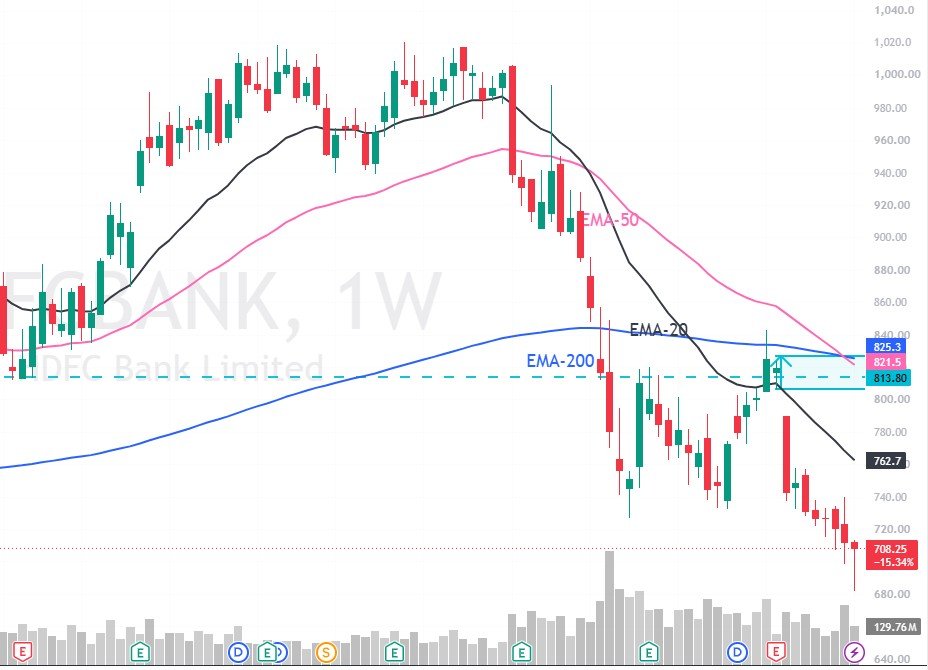
The technical setup remains neutral to weak.
The stock was trading around the recent ₹680-700 zone as of now, with bounce expected next week. For the chart, the important signals to monitor are:
For HDFC Bank, however, the bigger re-rating trigger is likely to remain fundamental NOT technical.
HDFC Bank is no longer being valued like the premium-growth bank investors were willing to pay for in earlier years. At around 1.8x book, the valuation is clearly below its historical range and closer to some of its large private-bank peers.
But the lower multiple is not without reason. ROE has moderated, NIM is under pressure and the bank is going through a leadership transition.
The positive side is that the underlying franchise remains strong. FY26 saw 12% credit growth, 14.4% deposit growth, stable ROA and better operating efficiency, while management has indicated an ambition to grow advances faster than the system in FY27.
The next phase is therefore about execution.
If HDFC Bank can stabilise NIM, maintain asset quality, improve operating efficiency and push ROE towards 15%+, the current valuation could leave room for a gradual re-rating.
If returns remain stuck around current levels, the market may have already adjusted the valuation to reflect the bank’s lower earning profile. For now, ROE recovery remains the clearest number to watch.
We share DAILY analysis of key stocks with charts and clear rationale for you to learn and decide. No Trading Advice is given
Disclaimer: This article is for information and education only and is not a stock recommendation. Investments in securities markets are subject to market risks. Read the full disclosures.
Choose structured trading education or explore our research-led trading call services.
Turn market understanding into a practical process with our research-led services.
Services by a SEBI-registered Research Analyst.